From childhood, Mphatso Kayenda dreamt of donning the military uniform.
She says every time she saw Malawi Defence Force (MDF) soldiers, she envisioned herself marching along the disciplined troops someday.
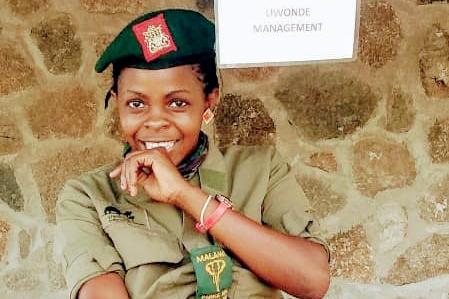
The game ranger comes from Namwera in Mangochi District.
She started her education at Kaloka Primary School before being selected to Majuni Secondary School where she obtained her Malawi School Certificate of Education.
Mphatso then retreated home and applied for a job as a regular soldier in response to a recruitment announcement from the MDF.
But it was never to be. She was not even invited for the interviews.
Life did not give her what she wanted. Mphatso had no opportunity to dress in the revered camouflage colours.
“The power and courage they display inspired me. l believed that one day l will wear the service uniform and hold a rifle,” she says.
Although her path did not lead her into military, destiny took her to something remarkably closer.
Mphatso’s association with African Parks’ community engagement projects since 2016 triggered a desire to participate in flora and fauna conservation.
“l felt connected to the African Parks mission of protecting wildlife, contributing to community development, reducing poaching and boosting tourism. The fact that rangers also carry guns in the course of their duty made me to be more interested in the job,” she says.
Having noticed similarities between military work and game ranger career, she automatically made the ranger job as a Plan B.
Mphatso convinced herself that serving the country in its protected areas would be closer to her initial dream.
In 2022, a basic ranger training vacancy arose in the Department of National Parks and Wildlife.
She applied for the job without hesitation. She got picked, but to her surprise, she was the only female trainee out of a cohort of 60.
“When I finally passed out as a ranger going through the rigorous training, I was filled with pride, joy and honour. It was unbelievable that a girl raised in a rural area could one day become a role model for her kin and peers,” she says with a smile.
Today, the 24-year-old-ranger stands tall as a reminder to girls in her community that it is possible for ambitious, determined girls to excel in careers that are considered to be a preserve for men.
The fifth born in a family of seven has broken gender barriers and challenged stereotypes by putting her best foot forward into the wilderness ready to defend wildlife from relentless poachers.
“My community now looks up to me. Apart from finding my own livelihood, I have also managed to live my dream,” says Mphatso.
She says her day involves monitoring wildlife, preventing poaching and engaging with local communities on conservation matters.
Mphatso says the training she received helps her to survive the jungle.
“l follow the tactics l acquired from training and apply them according to the situation. Above all, l trust in God,” she says.
But not everything is rosy for Mphatso. Some community members feel working in a male-dominated field takes away the dignity of a woman.
“Some even interpret it as something shameful. But l always find solace in reminding myself that this is what l wanted and l worked hard to achieve. No one can intimidate me, that is how l remain focused,” she says.
Despite the challenges, the young ranger is proud to be part of a larger team dedicated to protecting wildlife, which in turn contributes to Malawi’s economy through tourism and foreign exchange earnings.
Mphatso says her proudest moment was when, shortly after joining Liwonde National Park in 2022, she was chosen to be among rangers to participate in the World Day activities at Chikwawa Community Ground.
“That trip gave me the chance to meet fellow rangers from other parks in Malawi, share insights in wildlife conservation. This helped me to push my career a step further,” she recalls.
Mphatso calls for a mindset change in the way the citizenry views wildlife.
“It is high time we all developed a culture of protecting the wildlife. We should work together towards reducing poaching because wildlife is a God-given treasure. lf we embrace it, the country will benefit greatly,” she says.
The ranger also notes that written information about wildlife conservation is an essential tool of transferring information from one generation to the next.
She says proper documentation will help manage the knowledge required in preserving the country’s natural heritage.
“We need to have more stories and books that not only talk about wildlife conservation, but also highlight the different wildlife species our country has. This will help raise awareness and appreciation for the richness of our natural heritage,” says Mphatso.
She says one of the milestone of her career was last year when she was selected to be among 90 participants to the 21-kilometre annual ranger run.
“I was number one in the ladies’ category. It was unforgettable moment as l honoured with a medal, a bag of fertilizer, a bag of cement, cooking oil, sugar and other items,” she recollects.
In her free time Mphatso likes exploring new places.
On the dining table, her favourite meal is chips served with chicken.
Message to young women? The young ranger calls upon women to stand her ground, chase dreams and live it.
“Do not be intimidated and you will only succeed in something that you are truly passion about,” she says.